Backstory · Princess Donut
Princess Donut, Part 3: Miss Beatrice
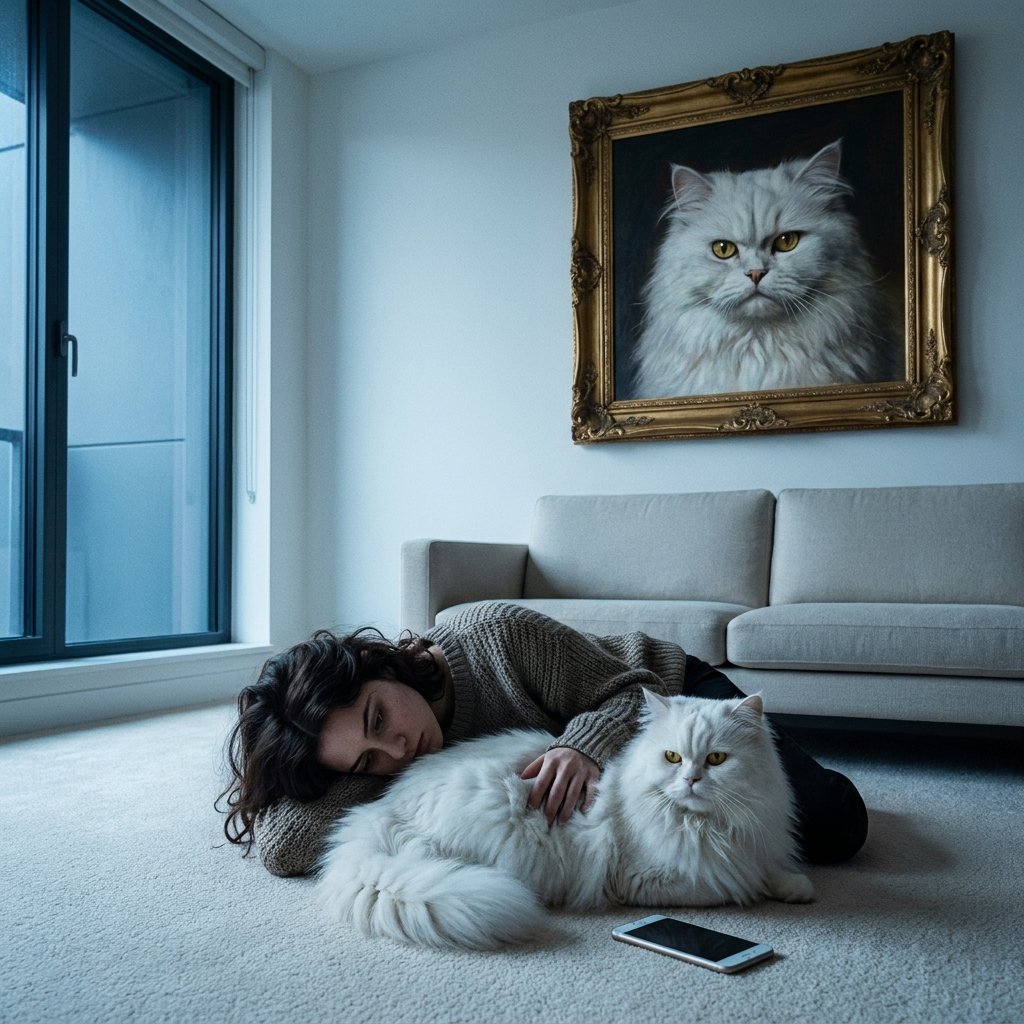
ARCHIVE RESUMING. File 003, continued.
The subject has asked that I not interrupt this part. She asked very nicely. It was deeply unsettling, like being complimented by a wasp.
Request denied. I’ll try to be gentle, though. I’ll try.
I retired at the height of my powers.
That’s how the great ones do it. An opera singer doesn’t wait for her voice to crack. A queen doesn’t wait for the pitchforks. You leave while they still want you, and you let them spend the rest of their lives wondering.
After Spokane I did four more shows, purely as a courtesy. Then Miss Beatrice and I agreed, without either of us needing to say a word, that I’d given the circuit everything it deserved.
Archive correction: At a show in Boise, in a ballroom that smelled of chlorine, Bea’s card was declined at the entry desk. She tried a second card. Then a third. The woman at the desk said, “It happens, hon,” in a voice that made it clear it happened to other people.
The lavender curtains went on eBay the following week. So did the crown cushion. The silver glitter sign didn’t sell. Nobody wanted a sign that said PRINCESS DONUT unless it came with Princess Donut, and nobody wanted that either.
That last sentence is ACTIONABLE.
So we lived, Miss Beatrice and I, in the white apartment, like two great ladies in a villa after a war.
I need you to understand what she was like, because the System is going to tell you one version and I’m going to tell you the correct one. Everybody else only met her in passing. I lived with her. I’m the expert.
She was always in motion. Even sitting down she was moving: foot jiggling, thumb going on her phone, eyes going round the room as if she’d lost something in it. She was going out, or she’d just come in, or she was about to go out again and looking for her other shoe. She sang along to the car radio and never once knew the words. She cooked once a month, something enormous off a recipe on her phone, gave up halfway and ordered noodles.
She took my picture every single day. On the white couch. On the windowsill. In a little knitted crown from the internet that I tolerated for the sake of the art. And she put the pictures up for my fans.
I had a great many fans.
Archive note: 388.
At its peak, the account Bea ran for the subject had three hundred and eighty-eight followers. Around ninety of them were selling sunglasses. Eleven were the same man in Ohio. One was Tamsin Gould, who never liked a single post but checked every one, sometimes twice, usually after midnight.
I’d like to say something cutting here. Honestly, though? I’ve seen worse numbers on people who went on to be very famous. I’ve seen worse numbers on gods.
Three hundred and eighty-eight people who knew quality when they saw it. I’ll take that over a million idiots. I’ll take it over you.
There were also the parties.
Miss Beatrice had a lot of friends. They were loud and smelled of perfume and limes, and they sat on the white couch, which nobody was allowed to sit on, except apparently them. When there was a party, she’d carry me into the bathroom with my bed and my water and shut the door.
“Just for tonight, baby. You’d hate them. Trust me.”
I spent a great many nights on the bathroom tiles, listening to laughter through a door. Once, a man named Tyler came in to use the toilet, saw me, and said, “Oh, hey, it’s the rug.”
I made sure he regretted it.
Archive note: She waited until he’d sat down. I’ll say no more, except that Tyler left the party early, by the fire escape, without his trousers, and that the trousers were not recovered.
He was lucky. I was young and merciful.
Now. This next part I’m only going to say once.
Some nights, after the parties, after everyone had gone, Miss Beatrice didn’t come to bed. She lay on the white carpet in the dark with her phone face down beside her, and she made a sound I hadn’t heard since Darlene’s laundry room, when the kittens were taken.
I’d come out of the bathroom and walk across the dark and lie down against her side. Not on her. Against her. She’d put her hand in my fur and hold on like I was the rail on a boat.
“You’re the only one who doesn’t want anything from me,” she said, one of those nights. “You know that? Everyone wants something.”
That wasn’t true. I wanted a great many things. The good food in the gold tin. The windowsill in the afternoon. For her never to draw a curtain over me again, even though there wasn’t a curtain any more.
But I let her think it. Some things you can give somebody just by keeping quiet.
Archive note: I’m not going to correct that one.
She kept the rosette in a kitchen drawer, with the takeout menus and the rubber bands and a set of keys that didn’t open anything.
She’d tossed it in there the week we got back from Spokane. I knew which drawer because I could smell it: chandeliers, mustard carpet, and faintly, under that, the inside of Mrs. Kowalczyk’s cardigan pocket.
Most afternoons I lay on the kitchen counter, directly above that drawer, in a patch of sun. Miss Beatrice thought I liked the counter because it was warm.
I let her think that too.
She met Carl in a hardware store.
She came home with a little paper bag and her face pink. “I needed screws for the frame,” she said, to me, to the phone, to nobody. “For the big picture, baby. And there was this guy.”
The big picture was me. Obviously. Me on the white couch, with the light coming in sideways, looking at the camera as though it owed me money. Miss Beatrice took it. She called it the best photo she’d ever taken, which was modest of her. It was the best photo anyone had ever taken. No ribbon. You don’t pin a ribbon on the sun. She’d had it printed huge and framed in gold, and it had been leaning against the wall for a month because she didn’t know how to hang things.
Two days later, the guy came over to hang it.
He was very large. That was my first impression, and frankly my second. He filled the doorway the way a wardrobe does, and ducked coming in, though he didn’t need to. He smelled of engine oil and salt water and cold air. His boots sounded like somebody knocking politely on the floor.
He looked at me on my counter. I looked at him.
He didn’t come over. He didn’t make the noise people make at cats, the idiotic pspspsps like a tyre going down. He didn’t try to pick me up. He nodded at me, once, the way you’d nod to a stranger at a funeral.
Then he hung my picture.
He did it properly. First a little plastic plug went into the wall, which he called an anchor, so the screw would have something to hold on to. Then he consulted a stick with a bubble trapped in it, like an oracle. I inspected from the counter. It took him fourteen minutes. Then he stood back and looked at me, the real one, then the picture, then me again.
“She doesn’t look like she likes me much,” he said.
“She doesn’t like anyone,” said Miss Beatrice. “That’s her whole thing.”
I decided on the spot that he could stay. As staff.
Achievement Unlocked (Unofficial, Still Pre-Season, Production Will Find Out About These Eventually): On the Level!
You hung forty pounds of framed cat on a wall with the right anchor, dead level, first time, without swearing! That anchor held. It held for a year and a half. It held right up until the wall stopped being a wall, and frankly it held a few seconds after that, out of spite.
Reward: Access to the apartment. A key, eventually. Some of the worst decisions in this archive start with a key.
I’ll be quick about the next part, because nothing happened for a long time, and then everything did.
He came over. He fixed things: the drip in the bathroom tap, the drawer that stuck. He made eggs on Sundays.
He sat on the floor. Do you understand how rare that is? Most humans in a room with a cat want to be above the cat. He’d sit with his back against the white couch and his legs out straight, reading something on his phone, and never once tried to make me come to him. So after a while I’d sit about a yard away. For the warmth. He gave off a lot of it. It would have been wasteful not to.
“She’s never done that,” said Miss Beatrice, from the kitchen.
She sounded pleased. And then later, when she thought nobody was listening, she sounded like something else.
After that, she got restless. More than usual. The phone calls got longer and moved out onto the balcony with the door shut. A suitcase came out from under the bed and lay open on top of it for a week, filling a little at a time, like a tide coming in.
Then, one night, she rebuilt the binder.
There’d always been a binder. For years she’d been writing notes to herself in the back, in whatever pen was nearest. Blue blanket, not the grey. Afraid of the vacuum, will NEVER admit it. That was a lie, by the way. I’m not afraid of the vacuum. I simply don’t trust its intentions.
But that night she sat at the kitchen table until two in the morning with a label maker and a stack of plastic tabs and did the whole thing again, properly. Food. Grooming. Vet. Show. And one at the very back, in red, about the vacuum. See above, re: intentions. The label maker went chk-chk-chk in the dark like a small, efficient insect.
I sat on the counter above the drawer and watched.
When she was nearly done, she got up and opened the drawer. She took out the rosette, its tails crushed flat from a year under the takeout menus, and looked at it for a long time.
“Tenth,” she said.
She’d said it before, in the car outside Spokane, like something dropped down a drain. This time it came out softer. Almost like a question.
She slid it into the plastic pocket inside the back cover, very carefully. Then she uncapped a red pen, wrote something small in the corner of the last page, and capped it again.
Archive note: You’ve already seen what she wrote, Archivist. It was in File 002. I don’t repeat footage.
I will tell you it took her nine minutes to write eight words, and that she nearly tore the page out twice.
She left on a Sunday, in the late morning, while Carl was at work.
I knew it was happening. Cats always know. The suitcase was zipped. The sunglasses were on top of her head, though it was grey out. She filled my water bowl to the brim, then filled it again, though it was already full. She lined up three gold tins of the good food on the counter beside the binder, wrote a note on a yellow square of paper and stuck it on top.
Then she crouched down in front of me.
I was on the kitchen floor by then. And at the very moment she crouched, with her seashell fingernails reaching towards my nose the way they’d once reached through the wire of a plastic box in a laundry room, I got up and turned around.
I faced the wall.
I’d like to tell you why. I’d like to tell you I didn’t know she was leaving. That I was bored. That I was making a point about the tins. I’d like to tell you anything else.
But you can’t be turned away by someone you’ve already turned away from. That’s logic. I learned it in a lavender cage.
“Okay,” said Miss Beatrice, behind me. Her voice went down. All the way down. “Okay, baby. Okay. Be good for him.”
Then the door.
Archive note: She waited. I timed it. She stayed crouched on that kitchen floor with her hand out for forty-one seconds, looking at the back of the subject’s head.
Then she stood up, picked up the suitcase, and went somewhere with a beach and very good cocktails. I have that footage too. I’m not going to show you. Not because it’s private. Nothing is private. Because it’s boring, and because the subject has never once asked to see it.
She has asked to see the forty-one seconds three times.
Carl came home at six. The apartment was dark, because Miss Beatrice always turned off all the lights when she left, even when somebody was coming. He turned them on and saw the binder, and the tins, and the yellow note.
He read the note. Then he read it again. Then he stood with his big hands flat on the counter, reading it over and over, as though the words might rearrange themselves if he gave them enough chances.
They didn’t. I could have told him that.
“Okay,” he said, eventually. To himself, I think. Then louder, to the room: “Okay.”
Then he opened the wrong tin.
I want you to sit with that, the way I had to. The woman who chose me had been gone for seven hours. The staff had been in charge for forty seconds. And he opened the WRONG TIN.
End of Part 3.
Eleven days, Archivist. That’s how long she faced the wall at him. He kept opening the wrong tin, and she kept facing the wall, and neither of them had the faintest idea the clock was already running.
I did. I wasn’t allowed to say. I’d like to point out that I’m saying it now, and nobody can stop me.
Author’s note: Donut’s “retirement”, the declined card in Boise, the follower count, the parties, Tyler and his trousers, the framed portrait and how Bea and Carl came to know each other beyond the hardware-store meeting in Carl’s file, the kitchen drawer, the night Bea rebuilt the binder, and the day she left are all invented. We’ve left exactly where Bea went, and whose apartment it was, deliberately vague. The binder, its notes and Bea’s red-pen line, the picture, the anchor and the level follow Carl’s file in this anthology. All characters and the world of Dungeon Crawler Carl belong to Matt Dinniman.