Backstory · Princess Donut
Princess Donut, Part 2: Tenth of Ten
ARCHIVE RESUMING. File 003, continued.
Before we begin, I’ve been asked to read a statement from the subject. Here it is in full: “Everything in the previous part was true, except the parts the System said, which were lies. Thank you.”
Duly noted. Also: spring came. The subject did not make a final. Bea did not take her back to Darlene’s. I’ll let you decide which of those surprised me more.
Rolling.
A cat show is not a dog show.
Carl once called it “the cat Westminster,” and I didn’t speak to him for an afternoon. A dog show is grown adults jogging in circles on a lawn, towing an animal on a string. A cat show is court.
Every weekend there’s a different ballroom in a different hotel in a different city. Spokane. Portland. Boise. A place called Puyallup, which I refuse to believe is real.
Archive note: Puyallup is real. Population forty-two thousand. None of them want to hear from you.
The ballroom is full of long tables lined with benching cages, and every exhibitor decorates their own: silk curtains, cushions, fairy lights, your name in curly gold letters. A whole street of tiny palaces. You sit in yours and receive visitors.
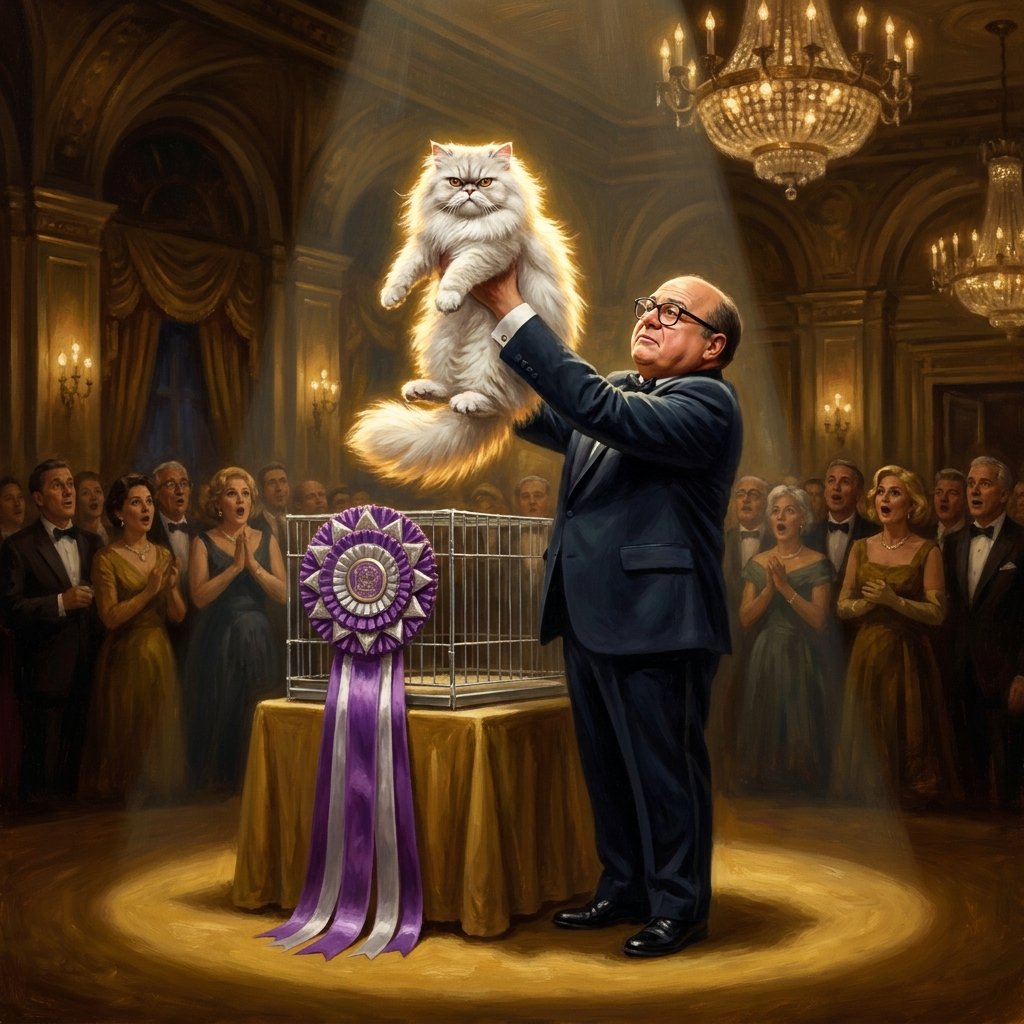
At the front are the rings. Your number is called, your person carries you up in her arms like a gift, and the judge stands you on a table under the lights. Eyes. Ears. Set of the head.
Then they lift you.
That’s the part I was born for. The judge takes you under the front legs and holds you up high, stretched out long, and for three seconds everybody in the ballroom is looking at one thing.
Then they put you down, write on a little card, and you go back to your palace to find out if you’ve won.
I always won.
Archive correction: I have the subject’s complete show record. Over four seasons she was entered in thirty-one shows and judged in roughly one hundred and forty rings. She won her class a respectable number of times. She was disqualified from two rings for biting, and from one for what the judge’s card describes as “sustained verbal abuse.” Underneath, in different handwriting, the judge has added (of me).
She made a final exactly once.
Hold on to that.
My palace had lavender curtains and a cushion shaped like a crown. Miss Beatrice made a sign with my name in silver glitter. It was the most beautiful thing in the room, except me.
The cage on my left belonged to Tamsin Gould.
Tamsin Gould had very straight hair and a voice like a paper cut. She showed a silver Persian called Lord Bartholomew, who was handsome the way a good lamp is handsome and had never once made a sound. Miss Beatrice hated Tamsin Gould more than anybody alive. You could tell, because she was always incredibly nice to her.
“Tam! Oh my God, he looks amazing, did you do something with his ruff?”
“Just brushing, Bea. Every day. You’d be amazed.”
The second Tamsin walked away, Miss Beatrice would type on her phone for a very long time with her mouth pressed flat.
I didn’t like Lord Bartholomew. He looked at me like I was weather. But I’ll admit he never bit anybody. He never had to. He just sat in the light and let people decide he was perfect.
I never learned how to do that. It’s a coward’s way to be perfect.
Archive note: Lord Bartholomew finished his career with forty-four rosettes, two regional titles and a portrait in oils. He was later reclaimed along with the rest of Tamsin’s townhouse. His final act on Earth was to sit very still in a sunbeam while the floor dissolved beneath him.
Never made a sound. Consistent to the end. I respect it. I found it excruciating to watch.
GOOD.
I’m sorry. That was beneath me. Moving on.
The cage on my right belonged to Mrs. Hester Kowalczyk, and to Gus.
Gus was a Maine Coon. If you don’t know what that is, imagine a cat that a raccoon once described to a bear. He was brown and black, in stripes, like a tiger left out in the rain, with tufts on his ears and paws the size of my whole head. He was very old, grey round the mouth, and slept through most of every show with his chin on his cushion.
Gus did not have a palace. Gus had a plaid blanket, and a sign, written in marker on the back of an envelope, that said GUS.
GUS. Not even a title.
Mrs. Kowalczyk was old too. White hair in a net, enormous glasses on a beaded chain, and a cardigan whose pockets were always full of tissues, mints and little paper cups of chicken.
And she talked. From the moment she arrived until the moment she left. She talked to Gus about her grandson in Phoenix, who didn’t call. About her knees. About the price of gas. About a cat she’d had in 1979, Mister Fitzwilliam, who once ate an entire stick of butter at a show in Tacoma and then won Best in Show anyway.
She talked to me, too.
Nobody else at those shows talked to me. They talked about me. Look at that coat. Is that the biter? Mrs. Kowalczyk put her face close to my bars and spoke to me as if I’d asked her a question and she was giving it real thought.
“Well, now,” she’d say. “Aren’t you having a day.”
I didn’t understand the words. I understood they were for me.
On long show days, when Miss Beatrice was off being nice to Tamsin Gould, I’d lie on my crown cushion with my back to the curtain and listen to Mrs. Kowalczyk on the other side. Just talking, the way rain talks on a roof.
That’s where I learned to fall asleep to somebody’s voice. I’m not saying it was important. I’m saying that’s where it started.
Archive note: I’ve counted. Across the eleven shows where the subject was benched beside Hester Kowalczyk, Mrs. Kowalczyk spoke an estimated two hundred and fourteen thousand words within range of the subject’s cage. About six thousand were addressed to her directly.
Four hundred and twelve of them were “Well, now.”
The subject purred during approximately one hundred and ninety thousand of the rest. She denies this. She denies it loudly.
I DO NOT PURR IN PUBLIC.
There’s a routine to a show weekend, and after a while it becomes a religion.
Thursday is the bath. Two baths. One with the degreaser, which smells of oranges and lies, and one with the real shampoo. Then the machine. A Persian coat takes hours to dry, brushed out section by section so that every hair stands up on its own like a soldier. Miss Beatrice did it on the bathroom floor with a grooming video propped against the toilet, swearing, mostly at the woman in the video.
Friday is the drive.
Saturday is court.
Sunday is court again, and then the final. If you’ve done well enough, your number is called one last time. The judge puts the ten best cats in the show in a row of ten cages, then brings you out one at a time and hangs a rosette on each.
A rosette is not a ribbon. A ribbon is a strip. A rosette is a ribbon that’s been to finishing school: a great frilled circle, long tails hanging down, gold writing in the middle.
Every weekend for two years, I sat in my lavender palace and listened to other cats’ numbers being called for the final.
Lord Bartholomew’s was called. Lord Bartholomew’s was called constantly.
Mine wasn’t. And every Sunday evening, as the ballroom emptied, Miss Beatrice packed up my palace without talking. Then she drew the lavender curtain shut over my cage, so I couldn’t see out and she couldn’t see in.
That was the hard part. Not the curtain. The quiet.
So I learned to get there first.
The minute the final started, I’d get up off my crown cushion and sit with my nose to the back of the cage. That way nobody could close me away. I’d already done it. You can’t turn away somebody who’s already turned away from you.
That’s just logic.
Status Effect Applied (Retroactive, Permanent): Facing the Wall.
You can’t be rejected if you reject them first! This is not true. It has never once been true, in any species, on any world I’ve harvested. But it feels true, and that’s going to have to do for the next several years.
Duration: Ongoing. Known cures: None on file. One possible cure has been noted in a binder, in red pen. We’ll get to that.
Then came Spokane.
The Midwinter show, in February. Chandeliers like upside-down wedding cakes and a carpet the colour of old mustard. Two hundred and twelve cats. I know the number now. I didn’t then.
I’d done well that weekend. I hadn’t bitten anybody, not even the judge with the cold hands. Mrs. Kowalczyk had brought Gus, and Gus had slept beside me all Saturday, breathing slowly, like something enormous and patient, and somehow that helped.
On Sunday afternoon the final started, and I did what I always did. I got up and faced the back of my cage.
And then I heard my number.
I didn’t understand words, but I understood numbers, because numbers were how I was called. On the other side of the curtain, Mrs. Kowalczyk made a noise like a kettle. Miss Beatrice made no noise at all. She opened my door, lifted me out, and carried me up to the front of the room in her arms like a gift.
The judge was a small round man in a bow tie. He set me in the first of the ten cages, at the far end. Then he called nine more numbers. Lord Bartholomew was one of them. So was a cream-coloured Burmese with a face like a disappointed aunt.
He took me out first.
He held me up in the light, high, stretched long, and the whole ballroom went silent. Every chandelier. Every person. Every cat. It was the longest anybody had ever held me up, and I didn’t bite him, and I’d like a medal for that alone.
He said something, and the room laughed. Then he hung a rosette on my cage. It was purple and silver, as big as a dinner plate, with tails that hung right down to the table. And it had gold writing in the middle. I’m going to tell you exactly what it said, because I’ve been told so many times since that I know it by heart.
It said BEST IN SHOW.
Archive correction: It said 10TH BEST CAT.
In a cat-show final, the judge presents from tenth to first. The first cat out is the tenth best. The subject was the first cat out.
Archive transcript, the judge: “Well, this one’s got opinions. Folks, this is my tenth best cat. And nobody tell her she’s tenth, because I don’t think she’d take it well.”
That was the laugh. Lord Bartholomew was fourth. The Burmese won, and looked exactly as disappointed about it.
LIES. It’s a CONSPIRACY, and the man in the bow tie was IN ON IT.
Miss Beatrice said one word on the drive home.
She said it pulling out of the car park, to nobody, very quietly, the way you’d say the name of something you’d dropped down a drain.
“Tenth.”
It was a down word. I didn’t know what it meant. I knew it went all the way down.
The rosette wasn’t in the car. She’d left it on the folding table in the ballroom with the empty cages.
I know what happened to it because Mrs. Kowalczyk told me. She told me then; I understood her later. She’d picked it up off the table and caught Miss Beatrice at the car door. She tucked it through the wire of my box, and it lay beside me all the way home, purple and silver, tails curling round my paws.
“You hang on to that,” Mrs. Kowalczyk said, through the wire. “Well, now. You hang on to that.”
I hung on to it.
She came to two more shows after Spokane. The second time, she came alone.
No Gus. There was the plaid blanket, folded on the table in front of her, and the envelope that said GUS, and nobody behind it. She sat beside my palace all day with her hands in her cardigan pockets, and for the first time since I’d known her, she didn’t say very much.
Late in the afternoon she put her face down close to my bars, and her big glasses slid down her nose on their chain.
“He was very old, sweetheart,” she said. “He was very, very old, and he had a good long time. That’s all anybody gets, if they’re lucky.”
Then, very softly, she started again. Phoenix. Her grandson. Her knees. A stick of butter in Tacoma in 1979.
I turned around and faced the curtain, and lay down, and fell asleep to it.
She didn’t come to the next show, or the one after that. I looked for her at every show for the rest of the season. I’m a princess. I don’t look. I survey. I surveyed for her.
Archive note: I don’t log the deaths of non-participants. They aren’t crawlers. There’s no notification format for them. I’ve had to make one.
Gus Kowalczyk has died. Maine Coon, brown tabby, aged nineteen. Cause of death: being nineteen. He slept through most of his last show with his chin on a plaid blanket, beside a white Persian he never once looked at. He didn’t need to. He knew she was there.
I don’t know why I made this. I’m leaving it in.
End of Part 2.
The subject would like the Archivist to know that she has the rosette. She’d like me to stress has. Present tense.
She does. But first it spends a year in a kitchen drawer with the takeout menus. And then a man with a screw shows up, and the woman who chose her packs a suitcase.
Author’s note: Everything about Donut’s show career here is invented, including her record, the Spokane Midwinter show, the purple-and-silver “10th Best Cat” rosette, Tamsin Gould, Lord Bartholomew and his fate, the Burmese, Mrs. Hester Kowalczyk and Gus. We’ve simplified real cat-show format (benching, rings, finals presented from tenth to first) for the story. Donut’s habit of facing the wall comes from the books, but the reason given for it here is our own speculation. All characters and the world of Dungeon Crawler Carl belong to Matt Dinniman.