Backstory · Carl
Carl, Part 3: Depends How Heavy
ARCHIVE RESUMING. File 002, continued.
Archivist, a content warning. This segment contains open water, a cold-weather rescue, a funeral, and a man trying very hard not to tell us about any of them.
You’d be amazed how much footage that generates. People who don’t want to talk will talk for hours, just to stay ahead of the thing they’re not saying. I’ve built entire floors around it. Lots of screaming.
TIME UNTIL PLANETARY COLLAPSE: 2 DAYS.
Nobody tells you the second-to-last day of the world is a Tuesday.
It just is. You get up. You go to work. You don’t get a trumpet.
It rained, finally. The sky had been threatening it all week, and on Tuesday it gave up and came down sideways off the water, into everything. The dock planks went black and slick. Lyle stood in the doorway of the shop office in a yellow slicker, looking out at it like it owed him money.
“Small craft advisory,” he said. “Nobody’s taking anything out. Go home if you want.”
“I’ll stay.”
“Suit yourself.”
He watched me rebuild a carburettor. Lyle did not watch people work. Lyle watched the weather and the Mariners, with the same expression for both. So something was coming.
“Can I ask you something?”
“You’re going to anyway.”
“Why’d you get out?” He nodded at my hands. At the whole of me. “Coast Guard. You’re good. You’re the best mechanic I’ve had in twenty years and you don’t even like boats. Why’d you get out?”
I set the float bowl down on the bench. I lined it up with the edge. Square. Then I wiped my hands on a rag for a lot longer than they needed it.
“Enlistment was up,” I said.
Lyle waited.
“That’s it. Enlistment was up.”
He nodded slowly. The Lyle nod. He’d done it about the cat. He’d done it about the boots. I was starting to understand that it didn’t mean I believe you. It meant okay, I’ll wait.
He went back to looking at the rain.
Archive note: “Enlistment was up” is true. It’s the kind of true that does most of its work by standing in front of something else, like a bouncer.
I respect it. I use it constantly. Every single word of my crawler handbook is true, and I’ve had beings read it cover to cover and still walk face-first into a room labelled ROOM.
Here’s what I didn’t tell Lyle.
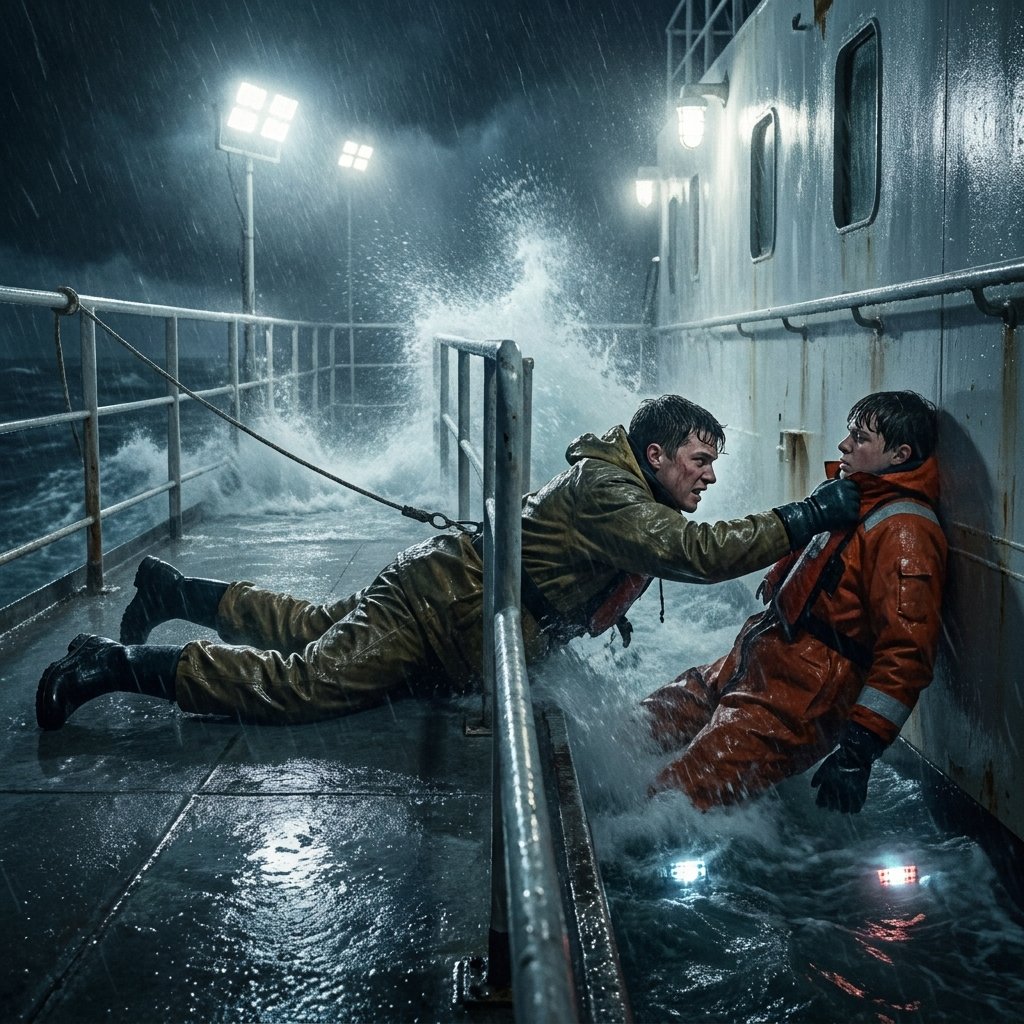
Three years in, we got a call in the middle of a January night. A crab boat taking on water forty miles out, in seas that were bad even for crab guys, and crab guys are insane. By the time our cutter got there the boat was on its side. There were lights in the water. Little strobes on survival suits, blinking white, rising and falling on swells taller than a house.
I was deck crew. Clipped in at the rail, wearing those boots, which were new then and stiff and gave me blisters on both heels. I remember the blisters more clearly than some of the faces. That’s what your brain does when it’s busy. It hands you something small to hold.
We got four of them out with the swimmer and the basket. That left two. A man and a kid. The kid was nineteen. His father was the captain. They’d tied themselves together with a length of line, which is either the smartest or the dumbest thing you can do in that water. I’ve gone back and forth on it for years.
The swell pushed them in against our hull. The kid came up right underneath me. I went flat on the deck, reached through the rail, and got a fist in the collar of his suit.
And then I just held on.
That’s all I did. I want to be clear. I didn’t do anything brave. I didn’t jump in. I lay on a steel deck in the dark with the North Pacific coming over me every eight seconds like somebody emptying a bathtub on my head, and I held a nineteen-year-old by the collar while the line between him and his father went tight, then slack, then tight.
Four minutes, they told me later.
It felt like the rest of my life.
Then the line went slack and stayed slack.
I don’t know if the knot failed or if the father cut it. He had a knife on his belt. Everybody on those boats does. I’ve thought about that knife more than I’ve thought about anything else in my life. I’ve decided, at different times, every possible thing about it.
They got the kid up in the basket. They never found the father.
The kid didn’t thank me. I don’t blame him. He looked at me while they wrapped him up, a long flat look, and I knew exactly what he was thinking, because I was thinking it too.
You had hold of the wrong one.
Achievement Unlocked (Retroactive): Half a Rope!
You held on to a stranger in open water for four minutes and didn’t let go! Not when your hand cramped. Not when the boat rolled. Not when you knew, around minute three, that you were going to end up with half of what you were holding.
Reward: I checked. Nothing in my entire loot table is better than what you already had in that fist. That’s extremely annoying, professionally. I’m giving you the achievement anyway, because otherwise I’d have to admit I was moved, and I’m not doing that on the record.
My mother died three weeks later.
I was at sea. By the time the message reached the cutter it was two days old and she’d already been gone for three. I’m not going to tell you how. It wasn’t him. Not directly. Not in any way a court would care about. But I’d known that house for eighteen years, and I’d left it for the Coast Guard the first second they’d take me. I knew what four more years in it without me would have cost her.
I got leave. I flew home. I went straight from the airport to the funeral home in my uniform and those stiff new boots, blisters on both heels.
My father was there.
He was sober. That was the worst part, honestly. I’d spent the whole flight preparing for the other version. A loud man in a bad suit who’d make a scene, so I’d have a reason to make one back. I’d rehearsed a speech over Montana.
Instead there was a quiet, grey, shrunken guy in the front row with his hands folded, looking at the casket like he didn’t understand how it had got there.
He looked up when I came in. At my uniform. Then at my boots.
“Those are good boots,” he said.
That’s it. That’s the only thing he said to me. Those are good boots.
I didn’t answer. I walked past him and sat at the far end of the front row with three empty chairs between us, and I stayed there for the whole service, and at the end I left without a word. I haven’t spoken to him since. I don’t know where he is. I don’t know if he’s alive. People tell me I’ll regret not finding out.
Maybe. Get in line.
But here’s what I worked out on the flight back to the cutter.
I’d been holding on to the wrong one my whole life. I’d been keeping my anger at him in my fist like a collar in the water, and I’d let go of her. I’d let the line go slack and told myself the knot had failed.
So I made a rule. I didn’t write it down. I’m not a rule guy. But I made it.
You don’t let go of the one who’s in front of you.
Not when it’s inconvenient. Not when they bite you. Not when they’re ungrateful, or someone else would be easier, or everyone around you is telling you to drop it. The one in front of you is the one you’ve got.
I didn’t re-enlist. I wanted a job where nobody could ship me forty miles from the people I was supposed to be holding on to.
Enlistment was up, though. That part was true.
Archive note: I cross-referenced the father. Of course I did. I have a file on everybody on this planet who was still breathing when the clock ran out.
I’m not going to tell you what’s in it. Not because I’ve been told not to. Because Carl doesn’t know, and he’s made it very clear that he doesn’t want to, and it turns out I’m capable of respecting that.
Who knew? Production didn’t. Production has asked me to stop. Production has asked me in writing.
That night I went looking for the vet’s number and found a crown.
It wasn’t a crown. I’m getting ahead of myself. I was at the kitchen table with the binder, going through the VET tab, because Donut had sneezed twice in a row and I’d decided, at eleven at night, that this was probably fatal. My hand went into the plastic pocket inside the back cover, and it came out holding something purple and silver and the size of a dinner plate.
A rosette. Ribbon tails hanging off it, crushed flat, like it had spent a year under a pile of takeout menus. Gold writing in the middle.
On the counter, the cat went very, very still.
“Tenth best cat,” I read.
Then I found the show papers. Spokane, behind a plastic sleeve. I ran my finger down the page, and there it was. The number of entries.
“Tenth out of — hang on.” I read it again. “Two hundred and twelve? Two hundred and twelve cats?”
I looked up at her. She was looking at me like I’d said something in a language she didn’t speak, and didn’t trust.
“Donut, that’s top five percent. You know what that is? In the Coast Guard, top five percent, they give you a medal and make you teach a class.” I looked at the rosette again. “Tenth. Jesus. Okay.”
I didn’t put it back in the binder.
Bea’s kitchen had one drawer, by the sink, that held a single thumbtack. Some drawers are just like that.
I took the thumbtack and the rosette over to the wall by the bookshelf. The patch she’d been facing every night for two weeks whenever I got the tin wrong. You could see the place. There was a faint smudge on the paint, exactly at nose height. Cat nose height.
I got down on one knee. Then lower. Then I was basically lying on the floor, holding a cat-show rosette against a wall and squinting at it like a picture frame, to make sure it was level.
I pushed the tack in with my thumb.
“There,” I said, and sat back against the bookshelf. “Now if you’re going to be mad at me, you’ve at least got something to look at.”
She didn’t come over. Not that night.
But she watched me the whole time. She didn’t blink once.
Notification: Item “Thumbtack (1)” has been reclassified.
Previous classification: Junk. New classification: Load-bearing. Archivist, I have never once reclassified a thumbtack. I’ve reclassified moons. I want you to understand the scale of what you’ve just witnessed.
TIME UNTIL PLANETARY COLLAPSE: 1 DAY.
On Wednesday, I almost took the picture down.
It hung by the kitchen door. A huge print in a gold frame, forty pounds if it was an ounce. Donut on the white couch, with the light coming in sideways, looking at the camera like the camera owed her money. Bea had taken it. Bea had called it the best photo she’d ever taken, and she was right.
It was the picture from the hardware store. The reason for the screw. She’d come up to me in the fasteners aisle holding a little paper bag and asked if those would hold, and I’d said depends how heavy the picture is, and two days later I’d come over with the right anchor and a spirit level and hung it in fourteen minutes. The cat had watched me from the counter the entire time like a building inspector.
It had been on that wall a year and a half. It hadn’t moved a quarter of an inch. I’d done a good job. I always do a good job with things that hang on walls.
It’s people I have trouble with.
I stood there with my hands in my pockets. Bea still hadn’t answered the text. Delivered. Not Read. I thought maybe I’d take the picture down. Not dramatically. I wasn’t going to smash it. I’d just wrap it in a towel and put it in the closet, so I didn’t have to walk past Bea’s best photo every time I went for a beer and think about the person behind the camera, and what she was looking at now instead.
Donut came and sat by my feet.
She looked up at the picture. Then up at me.
“Yeah,” I said. “I know. It’s you.”
I left it up.
Turns out it does depend how heavy the picture is. And some of them are heavier than they look. You use the right anchor. You check the level. Then you leave it alone, and it holds.
Outside, the rain had stopped, and the sky over the Sound had gone a colour I’d never seen before, a low orange that wasn’t sunset and wasn’t city light. Every dog on the block was barking. Then, all at once, none of them were.
The cobbler’s ticket was on the fridge under a magnet shaped like a crab. Ready Thursday, in neat old-man cursive.
Tomorrow was Thursday.
End of Part 3.
One day, Archivist. One more day.
I’ll tell you what tomorrow has in it, since he can’t hear me. Tomorrow he gets his boots back. Tomorrow his phone finally buzzes, and it isn’t good news, and it isn’t bad news, and somehow that’s worse.
And tomorrow night, at an hour I’m not going to give you, a front door he definitely, definitely locked is going to be standing open about the width of a cat.
Author’s note: This is a fan backstory. The books tell us Carl served in the Coast Guard and has a difficult family history, but the details here are our own invention, so treat them as speculation: the crab-boat rescue, the captain and his son, the timing and circumstances of his mother’s death, the funeral and his father’s one line, and the reason he didn’t re-enlist. The rosette, the Spokane papers and the “212 cats”, the single thumbtack, the framed portrait and the orange sky are also invented. The rosette scene and the portrait are told from Donut’s side in the Princess Donut file. All characters and the world of Dungeon Crawler Carl belong to Matt Dinniman.